

Phacoemulsification — commonly called “phaco” — is the world’s most widely performed cataract surgery technique, and it’s the standard of care at most eye hospitals in India today. If your ophthalmologist has recommended cataract surgery, there’s a strong chance they’re referring to phaco. This guide explains exactly what phacoemulsification is, walks you through the procedure step by step, compares it to laser cataract surgery, and covers everything you need to know about costs, risks, and recovery.
What Is Phacoemulsification? (Phaco Meaning Explained)
Phacoemulsification (pronounced fay-ko-ee-mul-sih-fih-KAY-shun) is a minimally invasive cataract surgery technique in which the cloudy natural lens of the eye is broken into tiny fragments, using ultrasonic energy and then gently suctioned out — all through a micro-incision of just 2.2 to 2.8 mm.
The term comes from Greek: phaco means “lens” and emulsification refers to the process of breaking a solid into fine particles suspended in liquid. After the lens is removed, a clear artificial intraocular lens (IOL) is implanted to restore vision.
The entire procedure typically takes 20 to 30 minutes per eye and is performed as a day-care procedure — no overnight hospital stay required.
Who Needs Phacoemulsification?
Phacoemulsification is used to treat cataracts — the gradual clouding of the eye’s natural lens. Common symptoms include:
- Blurred, hazy, or foggy vision
- Difficulty seeing at night or in low light
- Sensitivity to light and glare
- Seeing halos around lights
- Faded or yellowed colours
- Frequent changes in glasses or contact lens prescription
- Double vision in one eye
How Is Phacoemulsification Performed? (Step-by-Step Procedure)
Pre-Operative Preparation
Before surgery, your eye measurements (biometry) are taken to determine the correct IOL power. Antibiotic and anti-inflammatory eye drops are usually started a day or two before the procedure. You’ll be asked to fast for a few hours if sedation is planned.
Anaesthesia
Phaco surgery is typically performed under topical anaesthesia — numbing eye drops — so there is no injection into or around the eye. You remain awake but feel no pain. In some cases, a mild sedative is given to help you relax.
The Incision
The surgeon makes a tiny self-sealing incision of 2.2–2.8 mm at the edge of the cornea. Because the incision is so small, no stitches are usually required — it seals naturally after surgery.
Capsulorhexis
A small, precisely circular opening is made in the front of the lens capsule (the thin membrane surrounding the lens). This opening — called the anterior capsulorhexis — allows access to the cataract and later supports the IOL.
Lens Fragmentation with Ultrasound
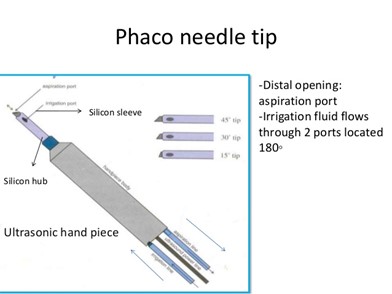
A thin ultrasonic probe (the phaco needle) is inserted through the incision. It vibrates at ultrasonic frequency (~40,000 times per second), breaking the cloudy lens into tiny fragments — a process called emulsification.
Aspiration of Lens Fragments
The fragmented lens material is simultaneously suctioned out through the same probe, while a balanced salt solution is irrigated into the eye to maintain pressure and protect the cornea.
IOL Implantation
Once the cataract is fully removed, a folded soft artificial intraocular lens (IOL) is inserted through the same micro-incision and carefully unfolded inside the empty lens capsule. The IOL stays permanently in the eye, restoring clear vision.
After The Phacoemulsification Surgery
Immediately after the surgery, the patient needs to wait in the outpatient recovery area to be monitored. You will be advised to rest for at least 24 hours when you will be asked to return to the Hospital for a follow-up. Only light meals are advised on the day of surgery. You may still feel a bit drowsy or may even experience slight eye strain or discomfort. Usually, some over-the-counter medications may also be advised for pain relief, but you must check first with the doctor.
If you experience any other side effects, for example, severe pain, nausea, or vomiting, you must report it to your surgeon immediately. You may feel some changes in the eye during recovery. Some patients also see dark spots. But these disappear within a few weeks after surgery. There might be some discharge and itching, also. Patients may use a warm, moist cloth to put on the eyes for 15 minutes at a time for relief and to loosen any particles on eyelashes, etc. The particles should be gently cleared away with soft tissue, not a fingertip. You may even experience some pain and sensitivity to light. Some patients may also have slight bruising or drooping which will improve as the eye heals.
Patients are asked to visit the Hospital on the day after the surgery. Your Eye Specialist will remove the eye cover and prescribe eye drops to prevent infections and control pressure from the IOL. These eye drops are to be used for about a month after surgery.
Next exams are usually at 1 week, 3 weeks, and 6 to 8 weeks following surgery.
Meanwhile, you will be advised to wear an eye cover while sleeping for 1 to 2 weeks. And no eye rubbing. During this time, you may be asked to wear special tinted sunglasses or the current prescription eyeglasses to prevent possible eye trauma from accidental rubbing or bumping. Unlike other types of cataract extraction, patients can resume normal activity almost immediately after phaco. After the eyes are healed completely, you will probably need new corrective lenses, at least for close vision.
Phacoemulsification Diagnosis
Phacoemulsification involves emulsifying or liquifying the natural lens of the eye. It is the latest, state-of-the-art, and extremely safe technology to remove the cataract.
The eye lens is located behind the iris, which helps to focus the light on the retina in order to produce clear and sharp images.
However, with the growing age, the lens hardens and loses its ability to accommodate. The entire lens is held within a lens capsule. As you grow older, oxidative processes occur. Proteins and dead cells accumulate in the lens capsule, which causes the lens to become cloudy. Due to this, the light doesn’t get focused and scatters around because of the cloudiness and the vision gets blurred. It loses its ability to give clear and sharp vision.
It has revolutionized the management of cataracts and visual rehabilitation. The technique has been much improved with the up-gradation in the technology and types of equipment. Thereby, the results of surgery have also undergone a huge change since then. Now we have much smaller incisions. The Quality of the foldable lenses has also developed a lot. Most of the cataract surgeries performed today are in the form of Phacoemulsification surgery. The reason behind this is its excellent visual outcomes, patient safety, and efficiency
Important Factors Concerning Phacoemulsification Surgery
Ophthalmologist
Choosing the right eye surgeon is crucial to the success of the operation because their expertise in this surgical technique is the main deciding factor of the outcomes of cataract surgery. Phacoemulsification surgery is a highly sophisticated method that depends on the surgical skill and experience of the performing doctor. It is essential that you choose a doctor with whom you can comfortably discuss your medical conditions. A good ophthalmologist will explain the risks and benefits of the surgery in detail, and assist you in making an informed decision about your eye health and visual needs.
Hospital
Selecting the right facility is important because it determines the operation theatre. Best Eye Hospital should be free from any possible contamination to ensure protection from infections. The right patient experience in pleasant surroundings will bring a feeling of well-being.
Technique and Lenses
The Eye Specialist will determine which surgical procedure will bring the desired results only after a thorough Eye Testing is done. Transplanting Premium IOLs provide better optics, therefore, they usually get better visual results. They minimize optical irregularities and neutralize some refractive errors, including astigmatism.
Eye Status
The last, but not the least determinant of surgical success is your eye health. If the patient is not suffering from any other eye diseases like corneal opacity and diseases, retinal disorders like age-related macular degeneration, glaucoma, In that case, the outcome of the surgery is excellent. Pre-existing refractive errors can usually be compensated for by choosing the appropriate IOL for the implant.
Risks
Complications occur in the rarest of rare cases. When a patient experiences spontaneous bleeding from the wound and recurrent inflammation after surgery. Flashing, floaters, and double vision are still there, even a few weeks after surgery. Such symptoms must be promptly brought to the notice of the surgeon. Some problems can easily be treated, while floaters, etc. may be a sign of a retinal detachment.
Retinal detachment is a very serious likely complication. The retina becomes detached by the surgery if there is any weakness in the retina. This complication may not be felt even after a few weeks or months.
Infections are another possible complication. The most serious one is Endophthalmitis. it is an infection in the eyeball. This problem, once widely reported, has become quite uncommon today because of better surgery techniques and antibiotics.
Patients may also be concerned that their IOL might become displaced, but innovations in the field of IOLs also have limited reports of intraocular lens dislocation.
Another potential complications are the onset of glaucoma.
It is also likely that a secondary cataract may develop in the remaining part of the capsule. This can happen for as long as one to two years after surgery. YAG capsulotomy is most often used for secondary cataracts. This outpatient procedure uses a laser and requires no incision. The laser creates a small opening in the remaining back part of the lens to allow light to penetrate.
Conventional or Phacoemulsification Surgery: A Comparison
In Extracapsular cataract surgery, the conventional method, the incision measures around 11mm and needs multiple stitches for closure. It may also require a suture removal at a later date.
The circular opening of the lens capsule in phacoemulsification surgery as compared to the irregular opening in conventional cataract surgery results in better stability of the IOL.
The incidence of surgically induced corneal astigmatism is less with phaco surgery. So the patient may not need glasses after the surgery.
The quicker and less complex phacoemulsification surgery means that the patient spends less time in the hospital during and after surgery. It reduces the economic burden on the patients and family. As the visual functions recover faster in cataract patients, they can return to work earlier, as well. Potentially threatening sight-threatening complications like vitreous loss, cystoid macular edema, wound leak, retinal detachment, and endophthalmitis occur much less. Due to the increased safety and efficacy of the phacoemulsification surgery procedure than conventional ones.
Phacoemulsification vs Laser Cataract Surgery
This is one of the most common questions patients ask. “Laser cataract surgery” typically refers to Femtosecond Laser-Assisted Cataract Surgery (FLACS or Femto), which uses a laser instead of a manual blade for the incision and capsulorhexis steps.
| Feature | Phacoemulsification (Phaco) | Femto Laser Cataract Surgery |
|---|---|---|
| Incision method | Manual microkeratome | Bladeless femtosecond laser |
| Capsulorhexis | Manual (surgeon’s hands) | Laser (computer-guided) |
| Lens fragmentation | Ultrasound probe | Laser pre-softens, then phaco |
| Precision | High | Very high |
| Astigmatism correction | Via toric IOL | Laser toric cuts + toric IOL |
| Recovery time | 1–2 weeks | 1–2 weeks |
| Cost (per eye, India) | ₹25,000–₹60,000 | ₹60,000–₹1,20,000 |
| Best for | Standard cataracts | Complex cases, premium IOLs |
For the vast majority of cataract patients, phacoemulsification delivers excellent results at significantly lower cost. Femto laser offers added precision for complex cases or premium lens implantation, but does not necessarily lead to better visual outcomes for routine cataracts.
Advantages of Phacoemulsification
- The vision is better than ever before, mostly, because the implanted IOL compensates for the earlier refractive error.
- Patients can choose to have special lenses that correct for distance alone (monofocal lenses), near and distance both (multifocal lenses), and even astigmatism (toric lenses).
- Much smaller incisions that do not require stitches or sutures.
- Better vision results in better mobility, better confidence.
- Another psychological result is the immense relief from the fear of blindness.
- Most patients report a clearer vision.
- Recovery time is much less, so the patients can resume their usual activities within two to three days of surgery. Whether it is watching TV, reading, or official duties also.
Disadvantages of Phacoemulsification
The disadvantages of the technique are few. Moreover, they are mostly due to the cost and availability of the machine and instrumentation. In poorly developed countries, this is the biggest hurdle to its adoption.
- Devices and instruments are expensive. It acts as a deterrent in many not-so-well-to-do parts of the world.
- The use of disposable equipment adds to the cost of surgery.
- Not all medical schools provide surgical skill and training, or even hands-on experience.
- Because of the lack of extensive training, the technicians do not gain much experience, in comparison to conventional cataract surgery. This lack of experience results in surgical complications like corneal damage.
- Some patients get anxious and may fidget during the operation. Phacoemulsification surgery requires a cooperative patient.
FAQs
The procedure typically takes 20 to 30 minutes per eye. It is performed as a day-care procedure, meaning patients can return home the same day without an overnight hospital stay.
The ICD-9-CM code for phacoemulsification with IOL implantation is 13.41. The corresponding ICD-10-PCS code used in procedure coding is within the eye surgery section, typically coded under cataract extraction with lens replacement.
Most patients can resume light daily activities within 2–3 days. Driving is typically safe within 1–2 weeks once the surgeon confirms adequate vision. Full visual stabilisation and a return to all activities including swimming occurs within 4–6 weeks.
If you are looking for the phacoemulsification technique or some other less expensive cataract surgery options, visit EyeMantra today. Call NOW at 9711115191 Or you can mail at eyemantra1@gmail.com. Our other services include Retina Surgery, Specs Removal, Low Vision Aids, which can help in correcting your vision.
You may also like:
Diet & Nutrition for healthy eyes
Medically Reviewed By

Senior Eye Surgeon | LASIK, SMILE & Cataract Specialist

