
Can Eyes Be Transplanted?
The short answer: partially, yes — but not the whole eye.
Certain parts of the eye — most commonly the cornea — can be successfully transplanted. Corneal transplants are performed routinely across India and the world, restoring vision to thousands of patients every year.
However, a complete eye transplant — removing one person’s entire eye and placing it in another person’s socket — is not currently possible. The reason comes down to one structure: the optic nerve. It connects the eye to the brain and carries all visual information. Medical science has not yet found a way to successfully reconnect a severed optic nerve, which means a fully transplanted eye cannot send signals to the brain and would not restore vision.
So when people ask “can eyes be transplanted?” — the more useful question is: which parts of the eye can be transplanted, and what does that mean for patients who need help?
Which Parts of the Eye Can Be Transplanted?
The human eye is made up of several distinct structures, each with a different transplant status. Here’s where science currently stands:
The Cornea- Fully Transplantable
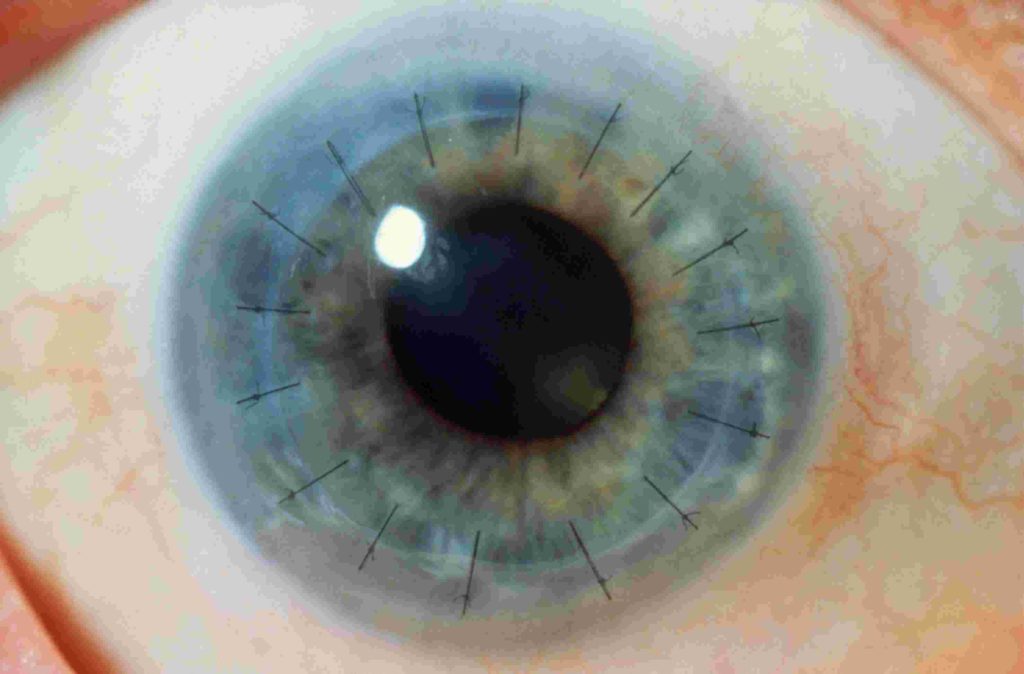
The cornea is the clear front surface of the eye that focuses most of the incoming light. It is responsible for focusing most of the light that enters the eye. When the cornea becomes scarred, cloudy, or misshapen due to disease or injury, vision becomes severely blurred or lost entirely.
Corneal transplant (also called keratoplasty) is the most common and successful eye transplant performed worldwide. The procedure involves replacing the damaged corneal tissue with healthy donor tissue. The results are excellent — most patients regain functional vision.
In India alone, hundreds of thousands of people are on waiting lists for corneal transplants. Eye donation drives exist specifically to address this shortage.
The Lens- Replaceable (with Artificial Lens)
The natural lens sits behind the iris and focuses light onto the retina. When it becomes cloudy due to cataracts, it can be removed and replaced — not with a donor lens, but with an artificial intraocular lens (IOL).
This is cataract surgery, which is one of the most commonly performed surgical procedures in the world. While technically not a “transplant” in the donor sense, it is a replacement of an eye part that restores vision successfully.
The Retina- Partially, With Limitations
The retina is the light-sensitive layer at the back of the eye. Retinal transplant research is ongoing, and there have been limited cases of partial retinal cell transplants — particularly for conditions like age-related macular degeneration (AMD) and retinitis pigmentosa.
However, full retinal transplants are not yet a standard procedure. Most retinal conditions are currently treated with injections, laser therapy, or emerging gene therapies rather than transplantation.
The Optic Nerve- Not Currently Transplantable
The optic nerve carries visual signals from your eye to your brain and once it is severed or significantly damaged, current medicine cannot repair or replace it. This is the primary reason a whole eye transplant remains impossible today.
Research in nerve regeneration is ongoing globally, and there are scientists working toward optic nerve repair — but this remains in the experimental stage.
The Whole Eye- Not Currently Possible
Despite remarkable advances in medicine, a full eye transplant is not medically possible today. Reconnecting the optic nerve to the brain in a way that restores functional vision has not been achieved. The US military has funded research in this area for wounded veterans, and some experimental work is underway — but no successful whole-eye transplant with restored vision has been performed in a human being.
Is a Full Eye Transplant Possible?
As of 2026, a full eye transplant that restores vision is not medically possible in humans.
Here is why: Vision does not come from the eye alone. The eye captures light and converts it into electrical signals, but it is the brain that interprets those signals as images. The connection between the two is the optic nerve — a bundle of over one million nerve fibres. No surgeon has yet been able to reconnect a severed optic nerve in a way that restores this communication between eye and brain.
There have been theoretical discussions and preliminary research, particularly funded by institutions studying treatments for veterans who have lost eyes in combat. Scientists at NYU Langone performed what was reported as the world’s first whole-eye transplant in 2023 — but while the transplanted eye survived and showed signs of connection, the patient did not regain vision in that eye. It was a significant scientific step, but not yet a functional restoration of sight.
For patients who have lost an eye, the current standard is a prosthetic eye (ocular prosthesis), which restores appearance but not vision.
Who Needs an Eye Transplant?
Corneal transplants are recommended when:
- Keratoconus has progressed to the point where contact lenses or glasses can no longer correct vision adequately
- The cornea has been scarred by infection (such as fungal keratitis or herpes simplex), injury, or chemical burns
- Corneal dystrophies such as Fuchs’ endothelial dystrophy have caused the cornea to become cloudy
- A previous corneal transplant has failed
- Corneal oedema (swelling) has caused persistent vision loss
If you are experiencing significant blurring of vision that cannot be corrected with glasses or lenses, persistent cloudiness in your vision, or eye pain accompanied by vision loss, a corneal evaluation is the right first step.
Eye Transplant Cost in India (2026)
The cost of a corneal transplant in India depends on the type of procedure, the hospital, the city, and whether donor tissue is procured locally or internationally.
| Procedure | Approximate Cost (One Eye) |
|---|---|
| Penetrating Keratoplasty (PK) | ₹40,000 – ₹80,000 |
| DALK | ₹60,000 – ₹1,00,000 |
| DSAEK | ₹70,000 – ₹1,20,000 |
| DMEK | ₹80,000 – ₹1,40,000 |
Note: These figures are indicative for 2026. Costs can vary based on the complexity of the case, imported donor tissue (when local tissue is unavailable), anaesthesia type, and post-operative care. Always request a detailed, all-inclusive quote from your hospital before proceeding.
In India, government hospitals and charitable eye hospitals often offer corneal transplants at subsidised or minimal cost for patients who cannot afford private rates. The National Programme for Control of Blindness supports corneal transplantation across the country.
Frequently Asked Questions (FAQs)
Some parts of the eye can be transplanted. The cornea is routinely transplanted with excellent results. The full eye — meaning a complete transplant that restores vision — is not currently medically possible due to the inability to reconnect the optic nerve.
Yes. Corneal transplants are performed routinely across India at major eye hospitals. India has a network of registered eye banks that source, test, and distribute donor corneal tissue. Waiting times vary by region and availability of donor tissue.
The surgery itself is performed under anesthesia and is not painful. Some discomfort, light sensitivity, and watering of the eye are normal in the first few days after surgery. Your doctor will prescribe appropriate pain relief and antibiotic drops to manage this.
Yes. Corneal transplants can be performed at any age, including in infants and young children born with corneal conditions. Pediatrics corneal transplant is more complex and requires specialized experience, but is performed successfully at centers across India.
A Word From Eye Mantra
Eye transplantation is a topic surrounded by both hope and misconception. At Eye Mantra, we speak to patients every day who have been told there is nothing that can be done for their vision — and in many cases, a corneal transplant is a genuine, life-changing option they were simply not aware of.
If you or a loved one has been diagnosed with a corneal condition, has experienced vision loss due to injury or infection, or has questions about what is possible for your eyes — we are here to help you understand your options with honesty and care.
We also actively encourage eye donation. Every donated cornea has the potential to restore vision to one or two recipients. It is one of the most meaningful gifts a person can leave behind.
Ready to speak with a specialist? Book your consultation at Eye Mantra today. Call: +91-9711115191
This article is for informational purposes only and does not constitute medical advice. Please consult a qualified ophthalmologist for diagnosis and treatment recommendations.
Medically Reviewed By

Senior Eye Surgeon | LASIK, SMILE & Cataract Specialist

