
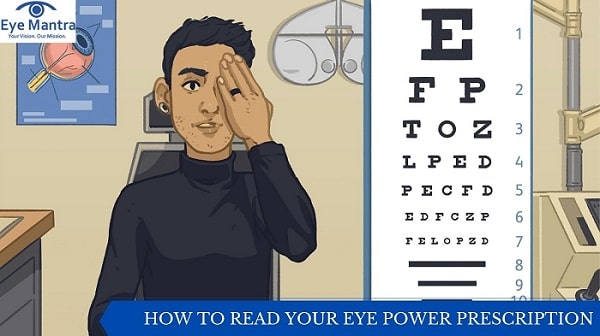
What Is Eye Power?
Eye power is the number on your prescription that tells you how strong your corrective lenses need to be. It usually ranges from 0 to ±20. 0 means normal vision with no lens needed, and the farther the number is from 0, the stronger your glasses or contact lenses need to be. Your prescription uses Latin abbreviations: OS (oculus sinister) for your left eye, OD (oculus dexter) for your right eye, and OU (oculus uterque) for both eyes. The unit of measurement is the diopter (D).
For example, +1.5D means hyperopia (farsightedness) with 1.5 power, while –2.5D means myopia (nearsightedness) with 2.5 power.
What are the terms used In Eye Power Description
O.S.
Oculus sinister denotes the left eye. Some doctors have started using LT left eye for the description
O.D.
oculus dextrus which represents the right eye also prescribed as RT.
SPH (sphere)
Sph the term in a prescription means the corrective for shortsightedness and longsightedness is spherical. Typical SPH no. ranges from 0 to +/-20. The farther the number is from 0, the thicker the lens you need.
CYL
short form of a cylinder. The number written under CYL indicates astigmatism (a condition under which your eyes are irregularly shaped)
AX
Axis explains the degree of astigmatism, which exceeds from 0 to 180. If you don’t have astigmatism then CYL and AX will be zero. AX and CYL go hand in hand, both are used to measure your astigmatism.
ADD (Added Power)
ADD is extra magnifying power added to the bottom part of your lens for
reading or close-up work. It’s most common in prescriptions for people over
40 who have presbyopia — the natural loss of near-focus that comes with age.
ADD numbers are always positive and usually range from +0.75 to +3.00.
PD (Pupillary Distance)
PD is the distance, in millimetres, between the centres of your two pupils.
It’s not a measure of your eye power — it’s used to position the lenses
correctly in your glasses frame so you look through the exact right spot.
A typical adult PD ranges from 54 to 68mm.
Vision
A vision test is done to check visual acuity. If your prescription says 6/6 vision, your vision is normal, and you see what an average eye at 6 meters can see. However, 6/6 vision doesn’t mean your vision is perfect. The best way to know your case is to ask your ophthalmologist.
Prism
The prism column is usually absent or blank in most of the prescriptions. Unless your eye muscles or nerves were affected in a way that caused double vision. The lens prescribed for prism ensures that light entering your eyes is focused on the retina correctly.
Base
The base is the direction applied to one or both of your eyes. Up, down, in, or out. base and prism work together.
To make it easier to understand here’s an example of prescription-
| Eye | SPH | CYL | AX | ADD |
|---|---|---|---|---|
| OD (Right Eye) | –2.00 | –0.50 | 90° | +1.50 |
| OS (Left Eye) | –1.75 | –0.75 | 85° | +1.50 |
What this means:
- Both eyes are nearsighted (myopia), SPH is negative in both.
- Both eyes have mild astigmatism, small CYL and AX values are present.
- Both eyes need +1.50 extra power for reading — likely presbyopia (age 40+).
- The right eye (OD) needs slightly more correction than the left eye (OS).
This is just one example, your own numbers may look completely different. If you’re unsure what your prescription means, our optometrists can walk you through it during a consultation.
Quick Reference Table: All Terms at a Glance
| Term | Full Form | What It Tells You |
|---|---|---|
| OD | Oculus Dexter | Your right eye |
| OS | Oculus Sinister | Your left eye |
| OU | Oculus Uterque | Both eyes |
| SPH | Sphere | Overall lens power (– for myopia, + for hyperopia) |
| CYL | Cylinder | Astigmatism correction strength |
| AX | Axis | Direction of astigmatism (0–180°) |
| ADD | Added Power | Extra reading power for presbyopia (40+ age) |
| PD | Pupillary Distance | Distance between your pupils (mm) |
| Prism | Prism | Corrects double vision, if present |
| Base | Base | Direction the prism is applied (up/down/in/out) |
Eye Conditions That Require Eyeglasses
Our eyes work like a camera that captures light from the object and forms an image. Light enters through the cornea outermost of our eyes and passes onto the retina which is the innermost layer of the eyes. When the light hits the retina, millions of photoreceptors send the signals to the brain and form and understand an image. Most of the eye power problems are because of where the light is hitting the retina.
Farsighted- Plus(+) sign before the numbers in your prescription indicates farsightedness or hypermetropia/ hyperopia means that person can see far objects clearly but finds nearby objects blurry and hazy.

Nearsighted- (-) minus sign indicates near/shortsightedness or myopia means the person can see nearby objects clearly but have a problem watching objects farther away. The numbers represent the diopter unit.
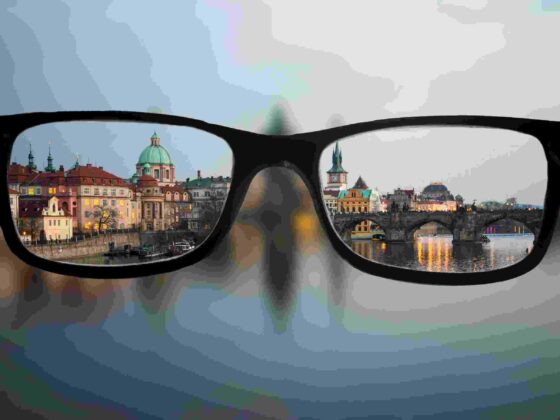
Astigmatism- In a healthy eye, the cornea or lens of the eyes is usually spherical shaped, but in the case of astigmatism, it is oval-shaped that doesn’t pass light evenly on the retina causing blurred vision. The orientation of astigmatism could vary from 0 to 180 degrees.
Presbyopia- Presbyopia is a usual eye disease that develops during aging (after 40). Our eye lens doesn’t remain flexible in our old age; as a result, the lens is unable to focus on objects right away. Presbyopia can be treated with bifocal lenses.

Symptoms You Need An Eye Power Corrective
A perfect vision is not promised forever, you may need corrective for normal eyesight, also if you already have glasses on, the number of your eye power keeps changing; not always in a negative way. It’s nothing to be afraid of but you should get your eyes checked every year to keep them healthy. If you have any of these, visit an ophthalmologist –
- Frequent Headaches– If you suffer from headaches often especially right after watching TV or reading, it is possible you need an eye corrective, although there could be other factors causing headaches, eye issues are prominent.
- Blurry vision– for example, if you’re trying to look at a poster far away and can’t see the details or if you find it difficult to read a book up close. You need a pair of eyeglasses.
- Halo ring on street light/ vehicles– During traveling at night if you find lines and halo ring around backlights of vehicles or even traffic lights you’re a possible eye patient of astigmatism.
- Dizziness– If your eyes feel sore, tired, and can’t concentrate on seeing things in aligning your eye power may not be normal. Although allergy, pollution can make your eyes dizzy too. Too much sunlight can harm your eyes too, therefore it’s best to protect them with sunglasses.
The Treatments To Improve Eye Power
Taking care of your eyes is like taking care of the rest of your body. And does not require much effort, making healthy choices every day like eating healthy, sleeping on time, exercising a bit can do wonders for your eyes and body as well. Eye diseases like nearsightedness and farsightedness can be cured naturally, but usually, eye diseases are not curable without surgery. If you want to avoid artificial lenses and glasses take care of your eyes from the very beginning. Here are some methods that can help-
Eat vitamin-A-rich food
Eating carrots, papaya, broccoli, green vegetables daily provides vitamin A to your eye cells that keep your eye power neutral.
Take a screen break
If you have a job in which you constantly have to stare at the computer screen then make the 20-20-20 rule. Take a break after every 20 minutes, for 20 seconds, and look at any object at least 20 cm far away. The rule will help your eyes from being sore and easily tired.
Sleep on time
You must have seen people with eye power don’t have a healthy sleep cycle. An irregular sleep cycle affects your whole body including your brain resulting in eye problems.
Eye power glasses/contact lenses
This is the easiest and effective way to treat bad eye power, wearing contact lenses could be a hassle though but glasses are super safe and convenient. There are three kinds of lenses- concave (used for myopia), convex (used for hypermetropia), bifocal lens used if the person has both nearsighted and farsightedness.
Surgery
Improving your eyesight naturally will only work if you constantly keep a look at your lifestyle and it still can’t be cured sometimes, whereas surgery can cure your eye power forever. However, you still need to take few precautions before and after your surgery.
Frequently Asked Questions?
1. What do OD and OS mean on an eye prescription?
Ans. OD (oculus dexter) means your right eye, and OS (oculus sinister) means your left eye. If a value applies to both eyes, it’s written as OU.
2. What does SPH mean on an eye prescription?
Ans. SPH (sphere) is the main power your lens needs to correct your vision. A minus (–) number means you’re nearsighted; a plus (+) number means you’re farsighted. The farther the number is from 0, the stronger the lens.
3. What do CYL and AX mean on an eye prescription?
Ans. CYL (cylinder) and AX (axis) together describe astigmatism — a condition where your cornea isn’t perfectly round. If you don’t have astigmatism, both values will show as 0.
4. What does ADD mean on an eye prescription?
Ans. ADD (added power) is extra magnification added for reading or close-up work, most commonly needed after age 40 due to presbyopia.
5. What is PD on an eye prescription?
Ans. PD (pupillary distance) is the distance in millimetres between your two pupils. It’s used to correctly position the lenses in your glasses frame, not to measure your eye power.
6. Can my eye power improve without surgery?
Ans. Natural methods like eye exercises, a nutrient-rich diet, and reduced screen time can slow decline and reduce strain, but they cannot fully reverse a refractive error like myopia. Glasses, contact lenses, or surgery
are the reliable ways to correct eye power.
Related Articles :
Medically Reviewed By

Senior Eye Surgeon | LASIK, SMILE & Cataract Specialist

