
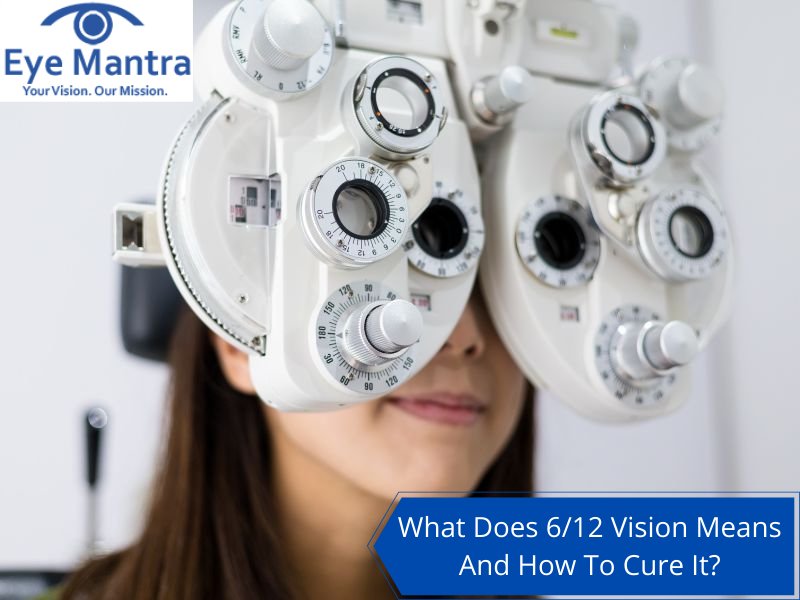
6/12 vision means you can see clearly at 6 metres what a person with normal eyesight can see from 12 metres away. It is a mild drop from normal 6/6 vision. In most people, it comes from a small refractive error, such as nearsightedness or astigmatism, that glasses can fix.
In this guide, we cover:
- What 6/12 vision means and how it is measured
- How much eye power 6/12 vision usually points to
- Whether 6/12 vision is bad and if you need glasses
- What 6/9, 6/18, and other vision scores mean
- Common causes, driving, and ways to improve or correct 6/12 vision
What Does 6/12 Vision Mean?
6/12 vision means you need to stand 6 metres from an object to see clearly what a person with normal vision can see from 12 metres away. That is about half the standard sharpness. It is also called “distance vision 6/12”.
Eye doctors measure this with the Snellen chart, a chart of letters that get smaller from top to bottom. You stand 6 metres away and read the smallest line you can. If that line is the 12-metre line, your vision is recorded as 6/12.
Key facts about 6/12 vision:
- The first number (6) is your testing distance in metres. The second number (12) is the distance at which a normal eye can read the same line.
- 6/12 is a mild reduction, not blindness.
- It is usually correctable with glasses, contact lenses, or laser surgery.
How Much Power Is 6/12 Vision?
6/12 vision does not tell you your exact eye power. The score (called visual acuity) shows how sharp your sight is. Eye power, measured in dioptres (D), shows the strength of lens you need. The two are linked, but they are not the same thing.
In simple nearsightedness (myopia), 6/12 vision without glasses often goes with a mild power of roughly −0.75 to −1.50 D. If you also have astigmatism or farsightedness (hyperopia), the same 6/12 score can come from a different power. Age, pupil size, and eye strain can change the result too.
Example: two people can both read the 6/12 line without glasses. One may need −1.00 D, while the other needs −0.50 D plus a cylinder (astigmatism) number. Only a refraction test by an eye doctor gives your real prescription.
To understand the numbers on your own prescription, read our guide on how to read your eye power prescription.
Is 6/12 Vision Bad? Do You Need Glasses?
6/12 vision is mildly reduced, but it is not dangerous. It is slightly worse than 6/9 and better than 6/18. Many people with 6/12 vision manage most daily tasks, but distant things such as road signs, the classroom board or a cinema screen look softer.
You should think about glasses if:
- Distant objects look blurry
- You squint to read signs or the board
- You get headaches or tired eyes after screen work or driving
- You have trouble recognising faces from a distance
What the result tells you:
- If glasses bring your vision to 6/6, the cause is a refractive error, and it is easy to correct.
- If glasses do not bring you to 6/6, ask your eye doctor to look for other causes, such as cataract, keratoconus, a corneal scar, or a retina problem.
A simple eye test is the only reliable way to know which case applies to you.
Vision Score Chart: 6/6, 6/9, 6/12, 6/18 and Beyond
| Score | What It Means | What You May Notice | Next Step |
|---|---|---|---|
| 6/6 | You see at 6 m what a normal eye sees at 6 m. | Clear distance vision. | Routine eye check-ups. |
| 6/9 | You see at 6 m what a normal eye sees at 9 m. | Slight blur with distant signs or TV. | Get tested. Glasses may help. |
| 6/12 | You see at 6 m what a normal eye sees at 12 m. | Mild blur at a distance. | Glasses may help if it affects your daily activities. |
| 6/18 | You see at 6 m what a normal eye sees at 18 m. | Distant signs and faces look blurry. | Get a full eye exam; glasses may help. |
| 6/24 | You see at 6 m what a normal eye sees at 24 m. | Faces and signs look blurred. | See an eye doctor soon. |
| 6/36 | You see at 6 m what a normal eye sees at 36 m. | Significant distance blur. | Get an eye exam. Refractive errors may be correctable with glasses or other options. |
| 6/60 | You see at 6 m what a normal eye sees at 60 m. | Only the largest letter on the chart may be readable. | See an eye doctor promptly for assessment and appropriate treatment. |
Note: your score does not give your exact eye power. Two people with the same score can need different lenses.
What Causes 6/12 Vision?
Most cases come from a refractive error, which means the eye does not focus light exactly on the retina. Common causes include:
- Nearsightedness (myopia): distant objects look blurry
- Astigmatism: an uneven cornea shape that blurs vision at all distances
- Farsightedness (hyperopia) and age-related changes: can blur vision, especially after 40
- Outdated glasses or contact lenses: a prescription that no longer matches your eyes
- Digital eye strain: tired focusing muscles can cause temporary blur
- Eye conditions: cataract, keratoconus (thinning of the cornea), corneal scars, or retina problems such as diabetic retinopathy
- Lazy eye (amblyopia) in children: one eye does not develop normal sharpness
If your vision stays at 6/12 even with the right glasses, an eye doctor should check for one of the eye conditions above
How Does 6/12 Vision Affect Daily Life and Driving?
6/12 vision mainly affects things you look at from a distance.
- Driving: it can be harder to read road signs and street names from afar. In many countries, 6/12 or better (with glasses if needed) is the usual standard for a private driving licence, but rules differ. Check with your local licensing authority.
- Screens and work: your eyes work harder to focus, which can cause headaches and tired eyes.
- Social situations: faces across the street or a cinema screen look softer without correction.
- Learning: students may struggle to see the board from the back of the classroom.
Wearing the right glasses removes most of these problems.
Can You Improve 6/12 Vision Naturally?
Partly. If your 6/12 vision comes from digital eye strain or tired focusing muscles, rest and good habits can help. If it comes from a refractive error like myopia or astigmatism, natural methods cannot reverse it. Only glasses, contact lenses, or surgery can correct that blur.
What can help your eyes:
- Follow the 20-20-20 rule: every 20 minutes, look at something 20 feet away for 20 seconds
- Spend time outdoors in daylight each day
- Eat leafy greens, omega-3 sources, and vitamin A-rich foods
- Wear your prescribed glasses and get regular eye check-ups
Read more:
Eye exercises that reduce strain | How to improve eyesight | Myopia and natural management
Treatment Options and When to See a Doctor
Ways to correct 6/12 vision:
- Glasses: the simplest and most common fix
- Contact lenses: a good choice if you prefer not to wear glasses
- Laser eye surgery: options such as LASIK, SMILE, and ICL can reduce or remove the need for glasses if you are a suitable candidate
See an eye specialist if:
- Your vision keeps getting worse
- Your vision stays at 6/12 or worse even with glasses
- You notice sudden blurring, double vision or eye pain
- Daily tasks like driving or reading become difficult
A full eye exam is the only reliable way to find out which option suits your eyes.
Conclusion
6/12 vision means mildly reduced distance sight, about half the sharpness of normal 6/6 vision. It is not blindness, and in most people a small refractive error causes it, which glasses, contact lenses, or laser surgery can correct. Natural habits help with eye strain but cannot reverse a true refractive error.
Is your vision getting blurrier? Don’t wait for it to get worse. Book a Free Vision Screening at EyeMantra Today
Frequently Asked Questions?
Ans. 6/12 vision means you see at 6 metres what a person with normal vision sees at 12 metres. That is about half the standard sharpness.
Ans. The score does not give an exact power. In simple nearsightedness, 6/12 vision often goes with roughly −0.75 to −1.50 D, but astigmatism, farsightedness, and age change this. Only an eye test shows your real prescription.
Ans. It is mildly reduced, not dangerous. Most people with 6/12 vision see well with glasses, though distant signs and screens may look soft without them.
Ans. Usually yes, if blur affects driving, studying, screen work, or recognising faces from a distance. An eye test will confirm the right prescription.
Ans. 6/9 vision means you see at 6 metres what a normal eye sees at 9 metres. It is slightly below normal and often goes with a small power. Glasses can help, especially for driving and screens.
Ans. 6/18 vision means you see at 6 metres what a normal eye sees at 18 metres. The blur is more noticeable than 6/12, so a full eye exam and glasses are advised.
Ans. If a refractive error causes it, laser surgery such as LASIK, SMILE, or ICL can often correct it, depending on your eye health. Your surgeon will check if you are a suitable candidate.
Ans. Natural habits can reduce eye strain, but they cannot reverse a refractive error like myopia or astigmatism. Glasses, contact lenses or surgery are the reliable fixes.
Ans. In many countries, 6/12 or better, with glasses if needed, is the usual standard for a private licence. Rules vary, so check with your local licensing authority.
Medically Reviewed By

Senior Eye Surgeon | LASIK, SMILE & Cataract Specialist

