
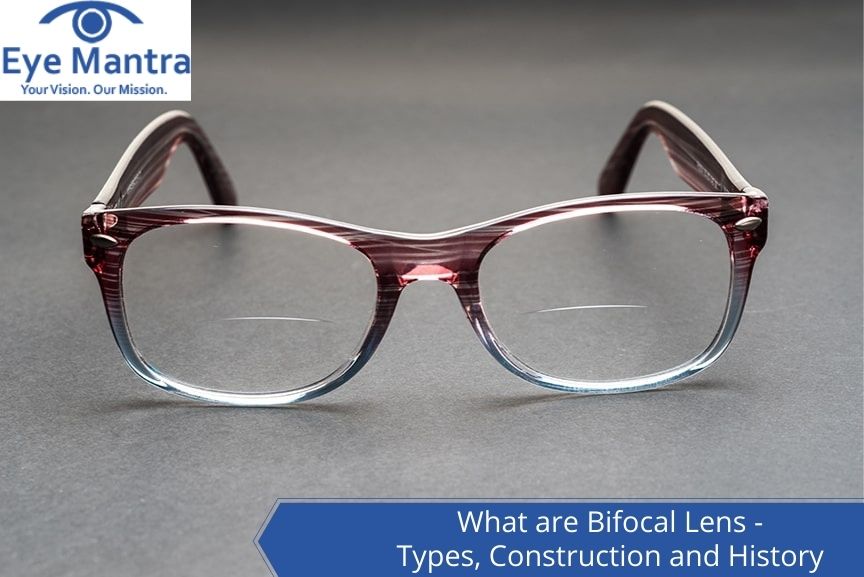
Sometimes, we fail to see two or three distinct objects at one time so opticians suggest us with bifocal – typically one to see far objects and one to see nearer objects which are called bifocal-lens. A bifocal lens also has two focal points, one will be used for viewing distant objects and one will be used to see close objects. It has a multi-focal lens.
Originally, the bifocal lens was invented by Ben Fraklin.
History of Bifocal Lens
A bifocal lens has a long history to go-
1938- Feinbloom from Newyork reported a segment bifocal CL and trifocal CL. However, they didn’t come in any clinical purpose as no measures were taken for the rotation of the lens.
1957-Declare in London, developed simultaneous-vision bifocal which was free from a rotational problem which now has become a basic formula for current bifocal lenses.
In the latter half of the 1980s and 1990s – The nonspherical progressive multifocal lens and diffraction progressive contact lens were introduced. In this phase, a large number of bifocal products were introduced. As some of the lenses got huge popularity while the demand of others got diminished over time.
In recent times, Bifocal lenses have improved a lot which now have developed modified mono-vision lenses with a difference you can make to right and left lenses and introduction of bifocal soft contact lenses came in, in which optical axis coincides with line-of-sight.
Use of a Bifocal Lens
1. Presbyopia
When you’re in your 40s, you naturally develop a disease called presbyopia in this, you gradually decrease the ability to focus on near objects and reading small print. As time goes, when you get into 45-47, it becomes a major issue in your life and everything you try to read from a closed range becomes extremely difficult for you to read. As said by doctors, that there’s no definite logic behind but it is said that with growing age your ciliary body muscles inside the eye don’t work well and become more inflexible.
2. Accommodative Dysfunction
Some people need a bifocal lens is because of accommodative dysfunction, children develop a condition where they are unable to focus from distance. They also face great fatigue while trying to focus near a distance or while reading or writing in the classroom.
3. Accommodative Esotropia
You will see in this disease during childhood period, that they start wearing bi-focal lens and this condition is called as accommodative esotropia. It is one of the common forms of esotropia which is a type of strabismus or also called eye misalignment. In this, the eye needs to focus hard to see any object clearly.
Types of Bifocal Lens
The types of bi-focal lens are categorized based on their size-
1. Flat-top
It has a small-segment shape like a half-moon or a letter “D” on its side. It is pointed towards the nasal and down toward the bottom. As advised by the doctor, their segment of the lenses is between 25 and 28mm and in the top segment, some lines are also visible on the lens.
2. Round Segment
In this, the round bifocal lens is of 22 or 24mm round segment towards the bottom of the lens. It is developed in a way to make your reading easy and but in today’s times, the round segment is not much used commonly.
3. Blended Bifocals
They were popular types of bi-focal lenses when no-line bifocals were not developed. These lenses are made up of a material that has a round segment, in which edges are blended inwards with the rest of the lens.
4. Executive Bifocal
These types of lenses are line bifocal, in which the top half part of the lens is that is used to see distant objects is completely different from the bottom half part that is used to see nearer objects. These types of lenses are commonly used by corporate people who need to sit on a desk starring computer for hours. But the popularity of these lenses got diminish over time due to unsightly lines present across the lens.
5. Progressive Lens
These lenses are invisible in nature, seamless, and have no visible line present on them. While wearing this type of bifocal lens, you will be able to see a gradual increase in transition in reading power as the lens is extended down toward the bottom of the lens without any visible line present to it. These lenses got popular in such a short span of time as they gave speckies a new different experience.
Bifocal Lens Price in India (2026 Guide)
The cost of bifocal lenses in India depends on the brand, the material (glass vs. CR-39 plastic), and additional coatings like Blue-Cut or Anti-Reflective. On average, standard bifocal lenses at EyeMantra start from as low as ₹500.
Bifocal Lens Price Breakdown
| Lens Type | Estimated Price (Per Pair) | Best For |
| Standard Bifocals | ₹500 – ₹1,200 | Budget-friendly daily use. |
| Kryptok (Round Seg) | ₹800 – ₹1,800 | Traditional durability. |
| D-Segment Bifocals | ₹1,000 – ₹2,500 | Wider reading area. |
| Blue-Cut Bifocals | ₹1,500 – ₹3,500 | Digital users (mobile/laptop). |
| Photochromic (Sun-Sens) | ₹2,000 – ₹5,000 | Users who move indoors/outdoors. |
Factors Affecting the Price
- Brand: International brands like Essilor (Varilux) or Zeiss will be at a premium compared to high-quality house brands.
- Index (Thinness): High-index lenses for strong prescriptions cost more but are significantly lighter and thinner.
- Coatings: Adding Anti-Glare (ARC) or Scratch-Resistant coatings typically adds ₹300 – ₹700 to the base price.
Construction of Bifocal Lens
When a bi-focal lens is designed with the use of a convex lens at the lower half, and the least use of convex lens on the upper part. In the 20th century, two lenses are cut in half and combined together, and made a frame out of it.
This method of fusing sections of the lens was developed by Louis de Wecker at the end of the 19th century.
In today’s scenario, the bifocal lens is created in a way by molding a reading segment into a primary lens.
Bifocal vs. Progressive Lenses Comparison
| Feature | Bifocal Lenses | Progressive Lenses |
| Appearance | Visible horizontal line across the lens. | “No-line” design; looks like single-vision lenses. |
| Vision Zones | Two zones: Distance (top) and Near (bottom). | Three zones: Distance, Intermediate, and Near. |
| Image Jump | Sudden “jump” when shifting from far to near. | Smooth, seamless transition between distances. |
| Intermediate Vision | No specific zone for computer/dashboards. | Dedicated middle zone for computer work. |
| Adaptation Time | Very quick; usually within a day. | Longer; takes 1–2 weeks to get used to. |
| Best For | Budget-conscious users or simple reading needs. | Modern lifestyles, office work, and aesthetics. |
| Price | Generally more affordable. | Premium pricing due to complex technology. |
While both lenses address presbyopia, the upper part of a bifocal lens is strictly for distance, whereas the top of a progressive lens slowly blends into intermediate power.
What is a Kryptok Bifocal?
Kryptok is a traditional fused bifocal with a round reading segment. It is an affordable and durable option for those who don’t mind the visible segment line.
Bifocal Anatomy: Upper vs. Lower Part
A bifocal lens is divided into two functional zones to treat presbyopia:
- The Upper Part: This is the largest section, designed for distance vision (driving, walking, and TV).
- The Lower Portion: A smaller “segment” at the bottom used for near vision (reading and mobile use).
- The Line: The visible boundary between these zones is the segment line, which can cause a slight “image jump” when you switch focus.
Conclusion: Are Bifocals Right for You?
Bifocal lenses remain a reliable and cost-effective solution for multi-distance vision. Whether you prefer the classic Kryptok style or want to upgrade to no-line Progressives, EyeMantra provides expert fitting and the best lens prices in India.
Ready for clearer vision? Book a Comprehensive Eye Exam at EyeMantra
Medically Reviewed By

Senior Eye Surgeon | LASIK, SMILE & Cataract Specialist

